

(Est. reading time: 11 mins. With Addenda, 13 minutes.)
Two questions seem to pop up whenever non-scientists (like me) get to talking about physics.
1- Is the speed of light really as fast as anything in the universe can go?
2- Says who?
The answer to the first question is easy. Yes, the speed of light is the ultimate speed limit of the universe. Nothing—nothing—can exceed 186,000 miles per second, written in shorthand as c.
“But what about tachyons?” is one inevitable comeback. Tachyons—from the Greek tachy meaning speed (think tachometer, tachycardia)—are particles that travel faster than light.
Tachyons don’t exist, except in science fiction novels, so let’s not waste time talking about them.
One thing to make clear before we dive into this. c only applies to light traveling in a vacuum. Shine a beam of light through some water or through a fiber optic cable, and it slows way down. In the case of water, light travels at about 140,000 miles per second, or about 75% of its speed in a vacuum. In a fiber optic cable, it’s even slower; about 124,000 miles per second.
The reason is simple: In a vacuum, light travels unimpeded. In a substance like water or fiber cable, it bounces off a gazillion particles that slow it down. For the purposes of this article, assume we’re talking just about light in a vacuum.
Now: Who says nothing can exceed c? Well, the universe does. And how do we know this?
This is the fun part. There are several completely different explanations for why c is the universal speed limit, and they all lead to the same conclusion. So here we go.
1- The Quantum Explanation
Quantum physics is a daunting topic, which is kind of odd since it’s based on extremely simple first principles. The most basic of these is that the universe is not smoothly continuous; it’s granular, which is a fancy way of saying the there is an ultimate limit to how small something can be, or how energetic, or how much charge it can have, etc. There is also an ultimate limit to how finely you can divide time.
That’s a brainful so maybe this will make it clearer. Remember the old riddle about a prince trying to reach a pot of gold? (He was actually trying to reach a princess but we practice safe science here.) With his first step he goes half the distance to the gold. With his next step he goes half the remaining distance, and then half of that distance with his next step, and so forth.
Q: How many steps before he reaches the gold?
A: He never gets there, because no matter how short the remaining distance, you can keep dividing it in half forever.
That might be true in classical physics, but according to quantum physics, there comes a point at which the remaining distance can no longer be divided. The prince reaches the point where there’s only one “quantum unit” of distance left, and he crosses it with his next step. There’s no halfway.
[I’m going to pause here to tackle an obvious question. If something crosses the quantum distance, at some point in its travel isn’t it only halfway across? The answer is no. To even talk of “travel” in the quantum world is fraught with problems. A more accurate way to look at it is that the particle in question ceases to exist in one place, and in the next tick of the cosmic clock it commences existing in the next place. It never “travels” at all. Yeah, I know, but go with it. Quantum mechanics is full of even whackier stuff than that.]
The quantum unit of distance is very real. It even has a name, the Planck length, named after the father of quantum physics. It’s very, very small, like so:
1.616 x 10⁻³⁵ meters
That’s .000000000000000000000000000000000001606th of a meter. To give you an idea of how small this is, imagine a single atom blown up to the size of the observable universe. At that scale, the Planck distance would be about the same length as a school bus.
There is also a limit to how finely you can divide time. The very smallest possible unit of time is this:
5.391 x 10-44 seconds
Or, .0000000000000000000000000000000000000000000005391th of a second.
Think of this as the rate at which the great cosmic clock ticks. Nothing happens in between two of those ticks. There is no such thing as “between two ticks.”
Both the Planck length and Planck time are unimaginably small, but the important point is that they’re not zero.
So here’s how you get the speed limit of the universe. The fastest that anything can go is to cross one Planck length in one tick of the cosmic clock. You can’t go two Planck lengths in one tick because halfway across would take half a tick and that’s not allowed.
Speed is just distance divided by time, like miles per hour or feet per second. If you divide the shortest distance possible by the shortest time possible (i.e,. Planck length divided by Planck time), you get—drum roll, please—186,000 miles per second.
And that’s that.
By the way, the next time someone tries to pay you a compliment by saying you made a “quantum leap,” bear in mind that a quantum leap is the smallest movement you can possibly make. Just sayin’.
2- Special Relativity and The Lorentz Transformation
Pretty daunting title, that. But don’t worry; this is easy.
We’ll go into relativity in a future edition, but here’s all you need to know right now.
Time is not constant. Time can elapse at different rates depending on where you are and what you’re doing. Remember the movie “Interstellar?” Some of the characters took off in a spaceship at nearly the speed of light and left a colleague behind. They were only gone for a few days but when they got back, the colleague they left behind had aged about fifty years.
This is valid physics. Back in the 60s, scientists synchronized two atomic clocks. They left one on Earth and put the other in an Apollo spacecraft for two weeks. When the capsule landed they compared the two clocks. The one that went to space, and traveled at 17,000 mph for two weeks, lagged the one on Earth by 22 millionths of a second, the exact amount predicted by Einstein’s Special Theory of Relativity
The faster something like a spaceship goes, the slower times passes for it. How much it slows is precisely known and is given by this formula, known as the Lorentz Transformation. (If that sounds like an episode of “The Big Bang Theory,” I agree!)

Stay with me. This is a very simple equation. t0 is just the time from the observer’s perspective (that’s the guy on Earth watching the spaceship fly away), v is how fast the spaceship is going, and c is the speed of light. You divide the original time by the result of the denominator to see how much time changes as you speed up.
Let’s start with what happens when the spaceship is standing still. In that case, its speed is zero, and the whole equation just becomes its original time divided by 1, which is the same as the original time. In other words, when the ship is standing still, time passes just as it normally does.
But what happens if it speeds up? In that case, v2 over c2 is no longer zero. Now the denominator is a little less than 1, and when you divide the original time by something less than 1, it gets bigger. The faster the spaceship goes, the faster time seems to pass for the guy on Earth.
More importantly, time on the spaceship slows down.
But don’t worry about that. Here’s the important part:
If you reach the speed of light, meaning v2 is the same c2, the denominator of our equation becomes zero. You can’t divide by zero. It’s not allowed. It’s the same as saying that time for the observer is going infinitely fast, which is absurd.
Which means that, when you hit the speed of light, time on the spaceship slows to zero. It doesn’t pass at all.
I know what you’re thinking: “If the spaceship goes faster than the speed of light, won’t time just become negative, meaning it’s running backwards?”
As with tachyons, only in science fiction stories. In real life, time runs one way only. Aside from that, let’s go back to that equation again:
If something was moving faster than light,

…would be a negative number. You can’t take the square root of a negative number, or you end up with mass (or time) greater than infinity. Buzz Lightyear notwithstanding, that’s a cosmic no-no.

Okay, what about light, which is composed of particles called photons? What happens to time for a photon, which does travel at light speed?
According to the equation we just discussed, time for the photon wouldn’t pass at all.
And that’s exactly right. Photons don’t experience the passage of time. Not ever. In fact, particles with no mass have to travel at the speed of light from the moment they’re created, and they have to do it forever.
3- The same thing, but with mass this time
I’ll make this brief. The faster something moves, the more its mass increases relative to an observer who is standing still. The amount of increase is the same as it was for time. The new mass is equal to:

Again, the faster something moves, the smaller the denominator gets, and the more the original mass increases. As it gets closer and closer to the speed of light (in other words, as v starts to get close to c), its mass starts to get really, really big. And the amount of energy you need to pour into it to get it to move faster also gets really big.
To get a single atom to move at the speed of light would take more energy than exists in the entire universe, plus a smidge. In fact, the amount of energy needed is infinite. And the mass would then be infinite. Well, there’s no room in the universe for something with infinite mass.
Once again, the speed of light is the ultimate speed limit of the cosmos.
4- Everything in the universe goes at the same speed
This one is my favorite.
Everything in the universe travels at the speed of light. Some things travel through space at the speed of light. Some things travel through time at the speed of light. Nearly everything travels through some combination of space and time, which is also known as the space-time continuum.
Here’s the important balancing act: If you add your speed through space to your speed through time, they always have to add up to the speed of light. The more one increases, the more the other has to decrease to keep that balance.
Let’s see how this works.
If you’re a beam of light or a radio wave, you’re traveling through space at the speed of light and your speed through time is zero. (Remember: Light, or any other form of electromagnetic wave, doesn’t experience time at all.)
If you’re standing still, in a parked car, say, you’re traveling through time at the speed of light and not traveling through space at all.
When you begin to drive the car, you have to move through space. To do that, you have to give up some of your travel through time so that travel through both time and space still add up to the speed of light. So if you’re traveling through space at some speed greater than zero, your speed through time has to get a little slower.
The faster you drive the car, the greater your speed on the road but the slower your speed through time. Time quite literally slows down for you. (Remember “Interstellar” and the atomic clocks on the Apollo mission.) If you should happen to drive that car at close to the speed of light, that is very fast indeed, at least through space, but your speed through time will slow to a crawl.
And, as we’ve seen, should you happen to reach the speed of light, you will not be moving through time at all.
Think of a seesaw. One side going up and down represents speed through space, and the other side speed through time.
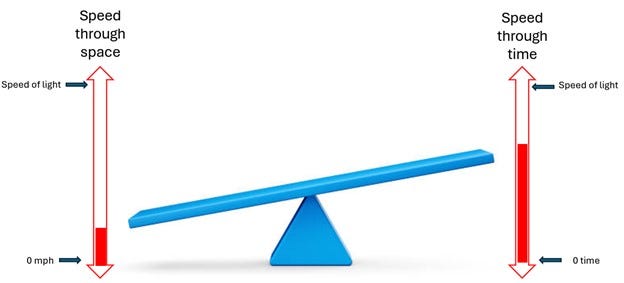
The total amount of speed available is the speed of light, represented by the red stuff filling the gauges. There’s only enough to fill one bar or the other completely, or it can be divvied up between the two. So the faster you go through space or time, the slower you go through the other.
If the left side of the seesaw is on the ground, you’re standing still and traveling through time at its normal rate.
When you speed up, the left side of the seesaw rises, but the right side drops. Your passage through time slows.
If you travel at the speed of light, the left side goes all the way up. The right side goes all the way down, meaning time isn’t passing for you at all.
There’s only so much red stuff, which is the speed of light. And that’s why nothing can ever go faster.
Addenda
Time Dilation
More correctly, relativistic time dilation. That’s the name for the change in how fast time flies when things speed up or slow down.
We mentioned above that this is a very real phenomenon that has been verified experimentally many, many times. (The same is true for nearly every other prediction of Einstein’s two theories of relativity. Read my Substack on Black Holes to learn about a really amazing one that even Einstein thought could never be verified.)
But, is time dilation just a scientific curiosity or does it have any practical impact?
It does indeed. If the engineers who built the Global Positioning System (GPS) didn’t understand relativistic time dilation and failed to take it into account, there’d be no GPS. That’s because most of its readings would be off by over a thousand feet. Let’s see why.
GPS is incredibly complicated but the premise on which it is based is simple. If you can determine your distance from any three fixed points on Earth, you can tell exactly where you are. This is called triangulation, and it’s been used for navigation for a very long time. In aviation, there are fixed radio transmitters on the ground all over the place. Instruments in an airplane can easily determine how far the plane is from each one and therefore compute the plane’s position.
That’s if the plane is flying over solid land. If it’s over the middle of the ocean, there are no radio stations and no way to perform triangulation.
Navigating that way in a car has its own problems. Owing to the curvature of the Earth, there are limits to how far away a transmitter can be and still reach your car.
GPS solves all of these by putting the transmitters in space, where their signals can be detected by any plane, vehicle, boat, tank or surveying tool on the planet.
But, the transmitters are no longer fixed. They’re zooming around the planet at many thousands of miles per hour.
No problem. GPS uses a couple of fixed stations on the ground to constantly calibrate the positions of each of the 32 satellites that comprise the system. When the GPS in your car gets a signal, it knows exactly where the satellite was when it was sent out and is therefore able to determine its distance and make the triangulation calculation.
Simple, right? Alas, no. There’s a problem.
The problem is that the satellite is moving, and moving really fast, about 9-12,000 miles per hour. While time dilation does occur if you’re in a car going 60, the effect is so slight that it doesn’t matter. But at 9,000 or 12,000 miles per hour, it matters a lot.
Time on the satellite passes more slowly than it does on Earth. It’s only by about 38 microseconds per day, but that’s enough to throw the entire system out of whack by 7 miles at the end of one day.
Atomic clocks on Earth tick at 10.2300000 megahertz (10.23 million times per second). In order to adjust for the effect of relativity, clocks on GPS satellites are tuned to run at 10.22999999543 megahertz. Without that adjustment, GPS would be useless.
Another time problem
This part is to keep you physics purists out there happy and stop you from sending me nasty emails.
I’ve greatly simplified the time dilation problem for GPS, because there are two relativistic effects going on when we talk about satellites in orbit. The one we discussed, that time slows down as things speed up, comes from Einstein’s Special Theory of Relativity, which he developed in 1905. But in 1912 he came up with his masterpiece, the General Theory of Relativity. We’ll get into that at another time, but one of its key predictions is that time slows down in the presence of gravity. The stronger the gravity is, the slower time passes. Again this has been proven countless times by experiment.
Gravitational force decreases over distance. The force of Earth’s gravity on a GPS satellite is less than 6% of what it is on the surface. That means that time on the satellite is passing faster than it is on Earth.
So now we have two differences between the passage of time on the Earth vs. on a GPS satellite. The fact that the satellite is moving fast means time is passing slower, but the lower gravity it experiences means time is moving faster.
The difference caused by the satellite’s speed is about 7 microseconds slower per day. The difference caused by the lower gravity is about 45 microseconds faster.
The adjustment made in the GPS circuitry is the net difference between these two effects, or about 38 microseconds per day.
Thanks again, Albert.
